
Beyond Decoupled Control:
Rethinking Whole-Body Navigation for Humanoid Robots
 University of Science and Technology of China
2
 Honor
3
 Beihang University
4
 University of Science and Technology Beijing
Abstract
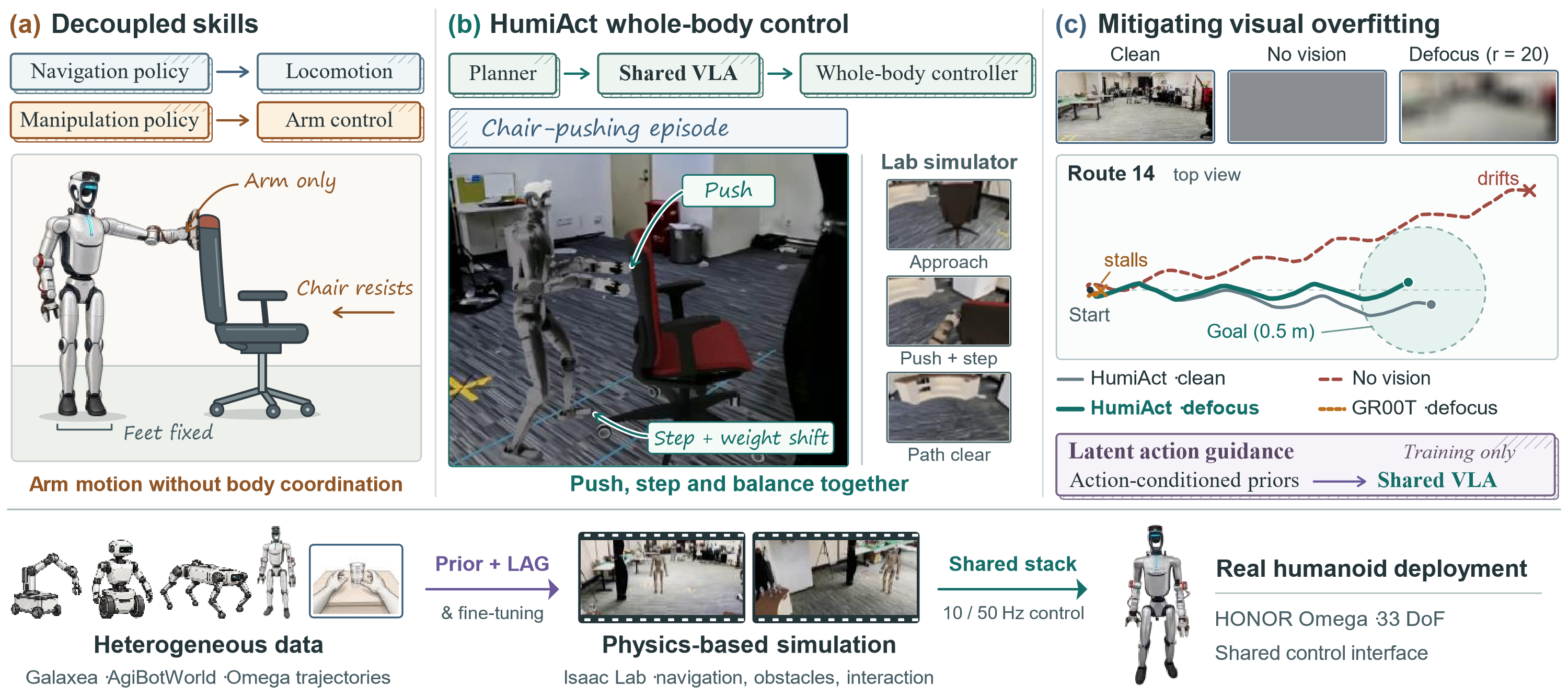
Humanoid robots hold promise for general-purpose embodied intelligence, yet their navigation systems largely inherit decoupled paradigms from wheeled and quadrupedal platforms. While such modular designs enable scalable optimization, they underexploit a key advantage of humanoids: the tight coupling of perception, locomotion, and physical interaction. Realizing this potential requires rethinking the conventional separation between navigation and manipulation.
In this work, we revisit whole-body humanoid navigation and present HumiAct, a unified framework that couples a high-level reasoning planner with a shared vision-language-action (VLA) policy and whole-body controller for coordinated planning, locomotion, and manipulation. We establish a training and evaluation ecosystem spanning heterogeneous datasets and physics-based simulation with paired-route protocols. Paired runs on the same routes reveal a vision dependence dilemma: camera feedback helps the humanoid stay on course, yet changing image appearance alone degrades performance due to reliance on scene-specific cues. We introduce latent action guidance (LAG) to distill action-conditioned motion priors from cross-embodiment navigation and manipulation trajectories into the shared policy, reducing appearance sensitivity without inference overhead. Built on GR00T, HumiAct's single shared policy outperforms fine-tuned baselines and separately trained specialists on direct navigation, planner-guided navigation, manipulation, and composed navigation–interaction tasks, and transfers to a physical 33-DoF humanoid.
Rollout Demonstrations
Additional closed-loop simulation and physical-humanoid rollouts executed by the same shared policy interface. Click the expand icon on any clip for Theater View.
Method
Unified Whole-Body Control
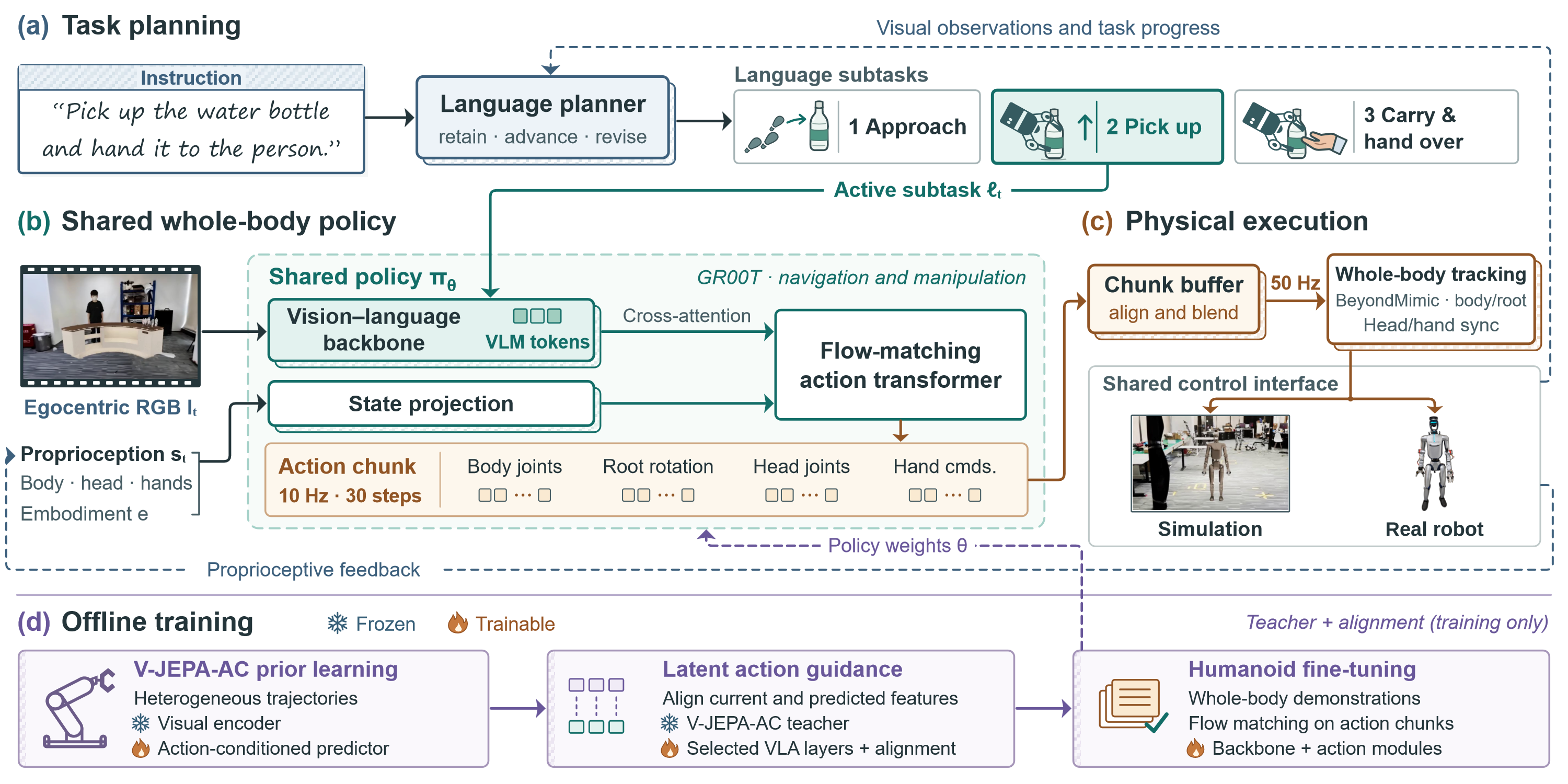
HumiAct unifies navigation and manipulation across three tightly coupled levels. A high-level language planner decomposes a long-horizon instruction into ordered short subtasks and periodically evaluates visual progress to retain, advance, or revise the active subtask. One shared GR00T-based flow-matching VLA policy maps the active subtask, egocentric RGB, and 37-D proprioception to synchronized 30-step action chunks at 10 Hz covering body joints, root orientation, head pose, and hand commands. Buffered references are smoothly blended and streamed at 50 Hz to a single BeyondMimic whole-body tracker across both Isaac Lab simulation and the physical 33-DoF humanoid.
Latent Action Guidance (LAG)
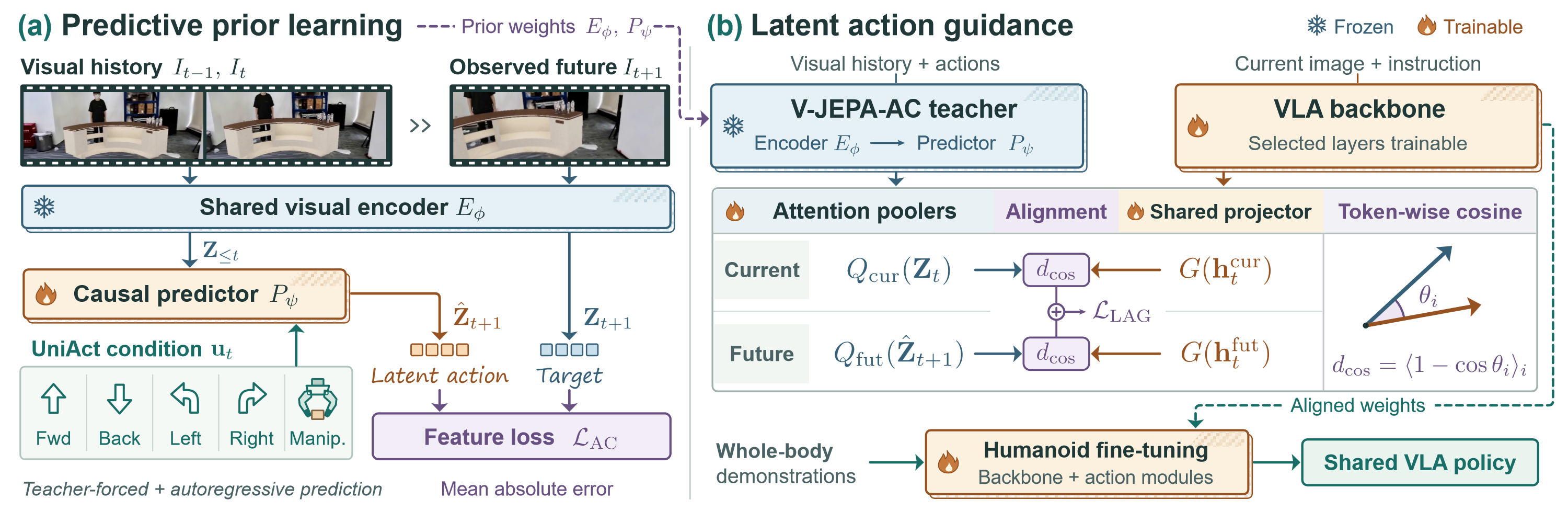
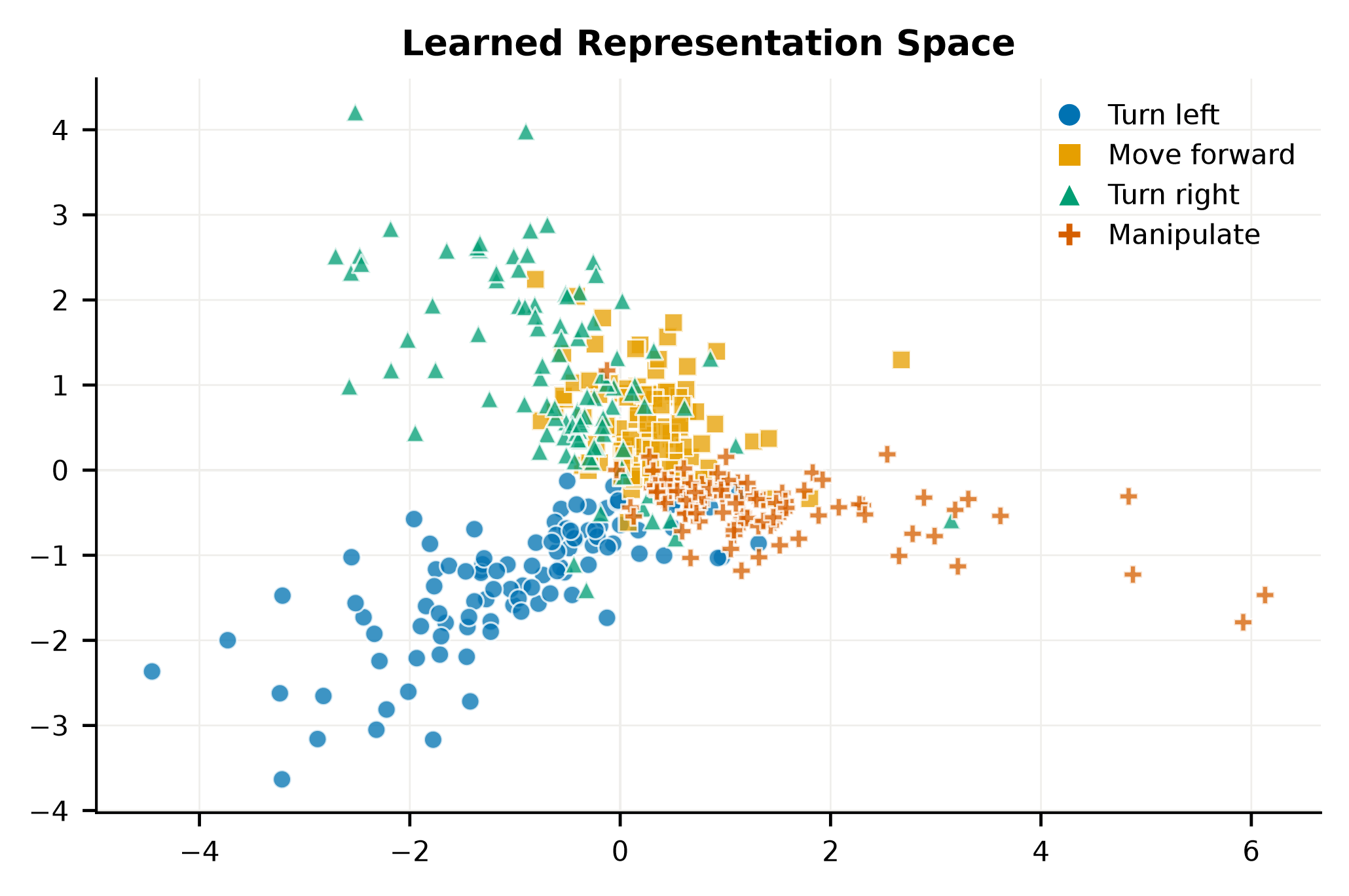
To preserve closed-loop visual steering without overfitting to static training backgrounds, we first map 178,384 cross-embodiment episodes (AgiBotWorld, Galaxea, and humanoid trajectories) onto five shared behaviors (forward, backward, turn left, turn right, manipulate) and train a 24-layer causal V-JEPA-AC predictor over frozen ViT-giant features. During Stage 2, frozen current and predicted future teacher features supervise 32 auxiliary tokens in the VLA backbone via token-wise cosine alignment. After joint whole-body fine-tuning on 5,421 humanoid demonstrations, the teacher, auxiliary tokens, and alignment modules are discarded—leaving zero inference-time overhead.
Experiments & Analysis
All compared policies share the same 5,421-episode humanoid corpus, 200k-step fine-tuning schedule, and 50 Hz BeyondMimic controller under route-paired evaluation.
Table 1. Whole-body task performance in simulation. 15 routes per navigation setting (default planner: GPT-5.6 Terra) and 32 trials for composed navigation–interaction. SR and Coll. in %.
| Method | Direct Nav. | Planner Nav. | Manip. | Nav. + Interaction | ||||
|---|---|---|---|---|---|---|---|---|
| SR ↑ | SPL ↑ | SR ↑ | SPL ↑ | Coll. ↓ | SR ↑ | Reach ↑ | Complete ↑ | |
| Manipulation-only specialist | – | – | – | – | – | 32.0 | – | – |
| Navigation-only specialist + LAG | 73.3 | 0.574 | 46.7 | 0.330 | 40.0 | – | – | – |
| GR00T (fine-tuned baseline) | 66.7 | 0.517 | 33.3 | 0.258 | 26.7 | 33.0 | 43.8 (14/32) | 6.3 (2/32) |
| Prior-initialized reference | 73.3 | 0.540 | 53.3 | 0.385 | 46.7 | – | – | – |
| HumiAct (Ours) | 86.7 | 0.705 | 53.3 | 0.410 | 46.7 | 36.0 | 56.3 (18/32) | 15.6 (5/32) |
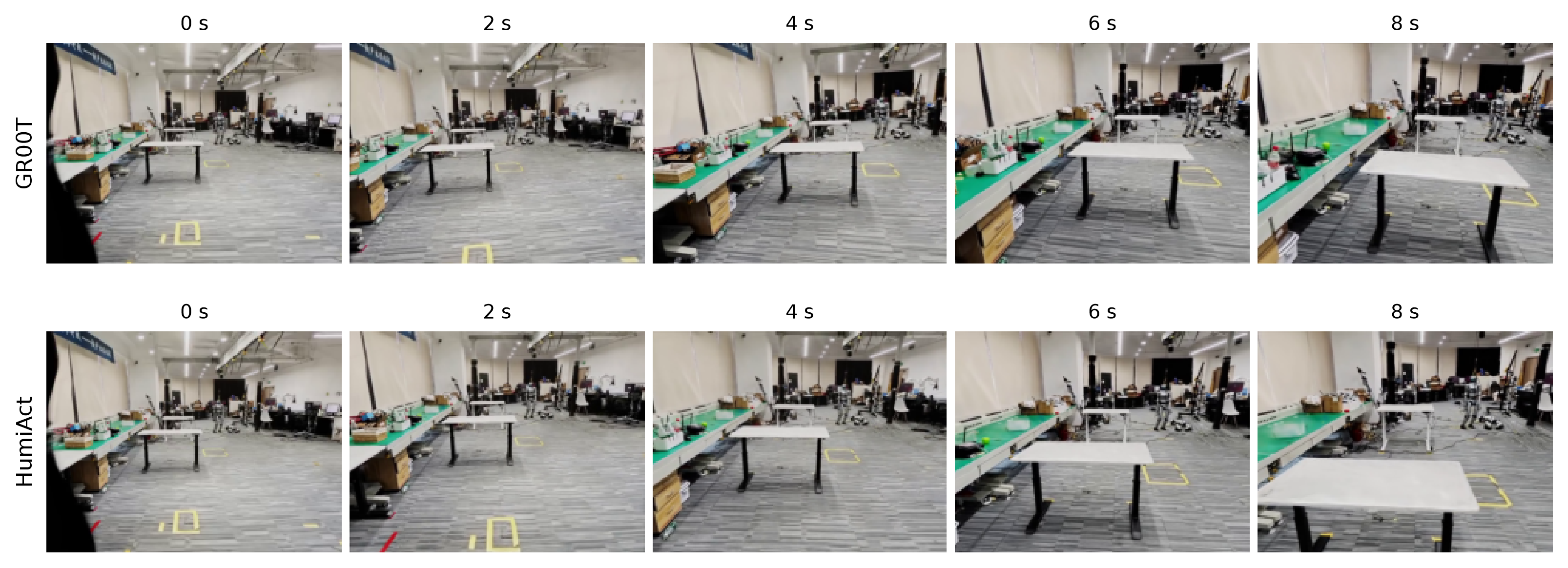
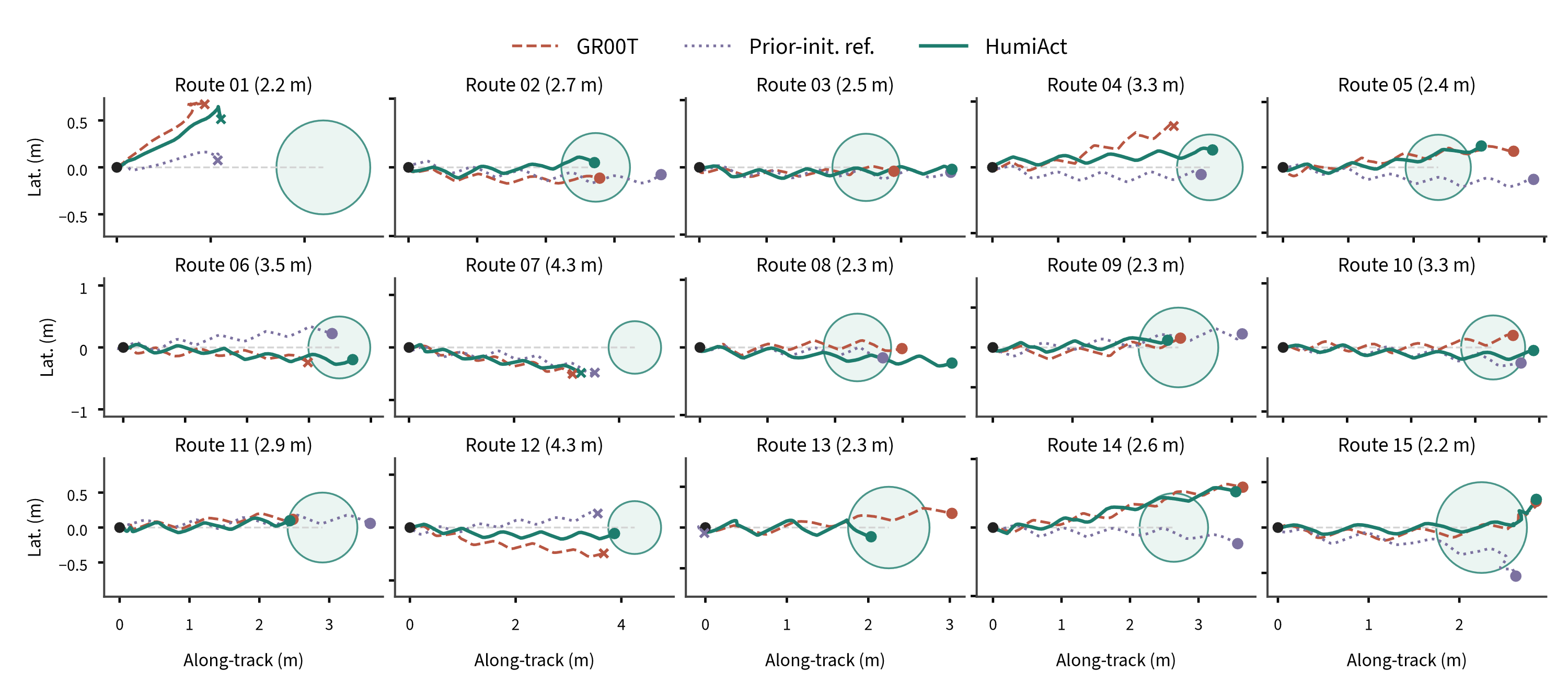
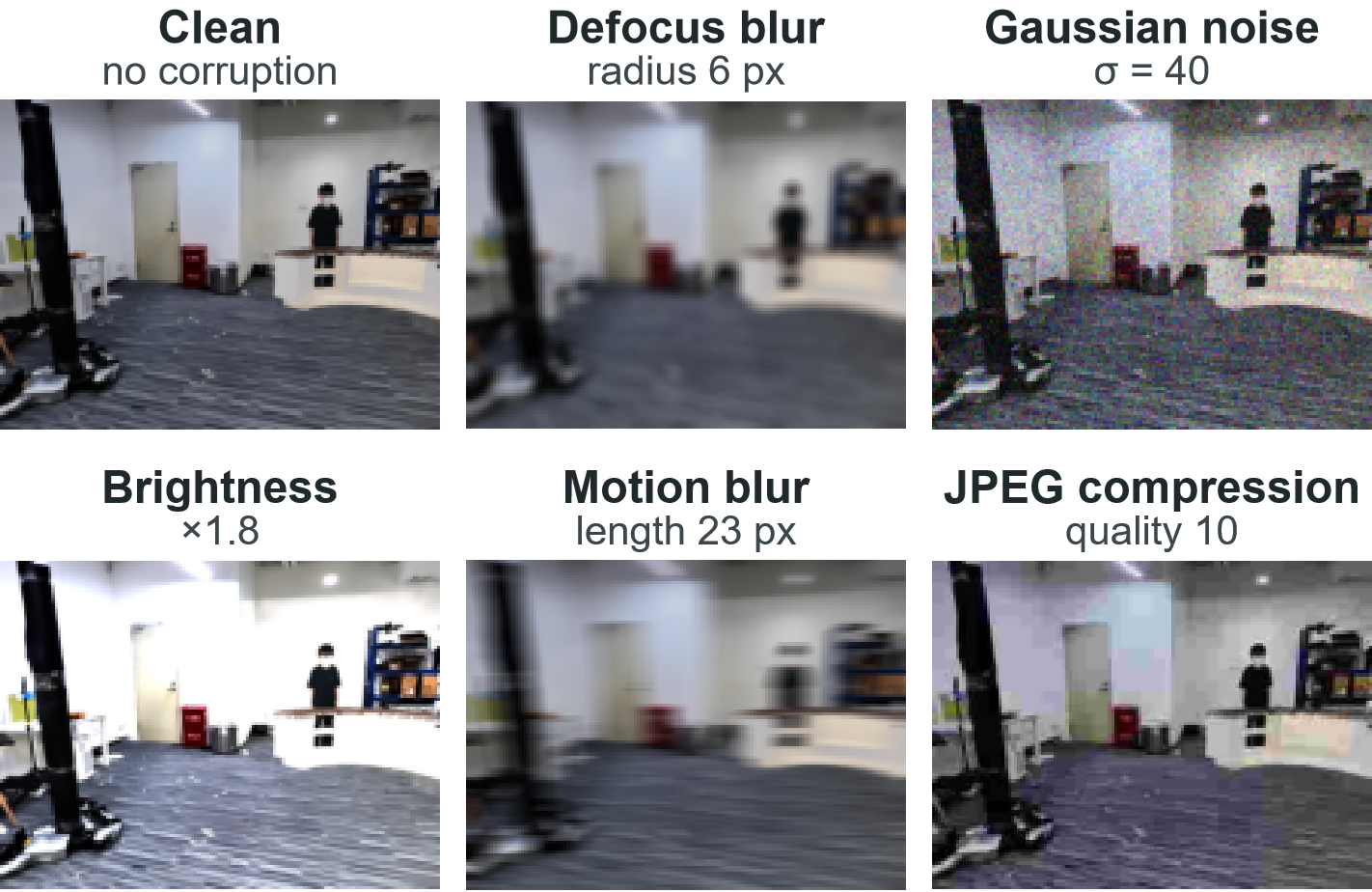
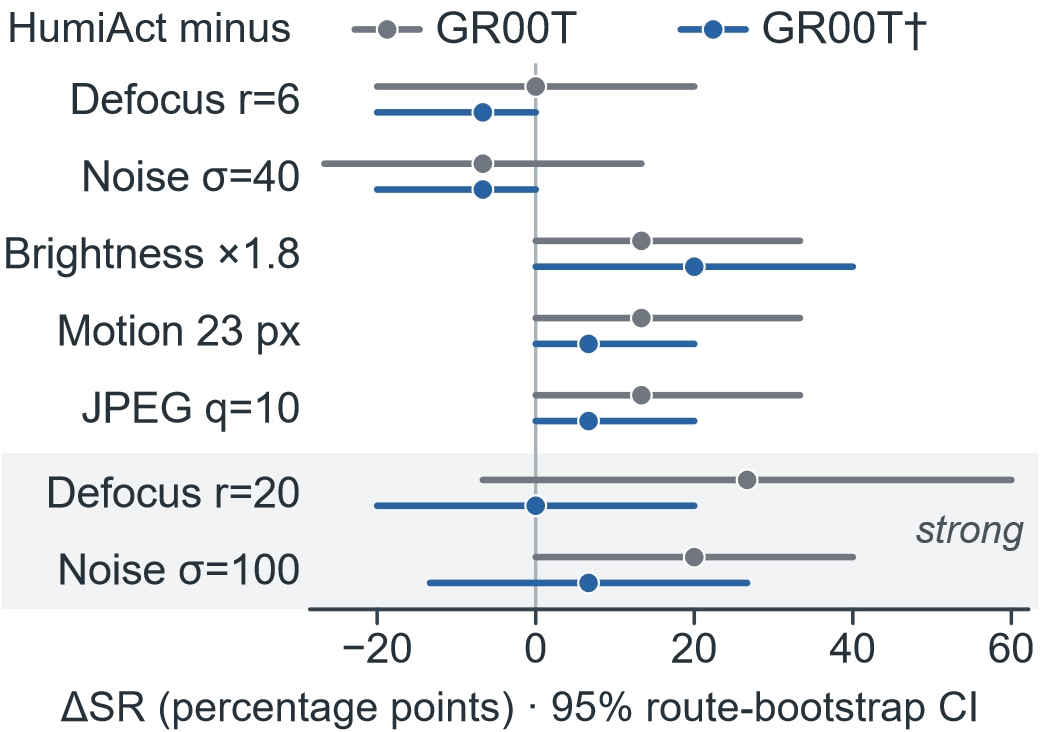
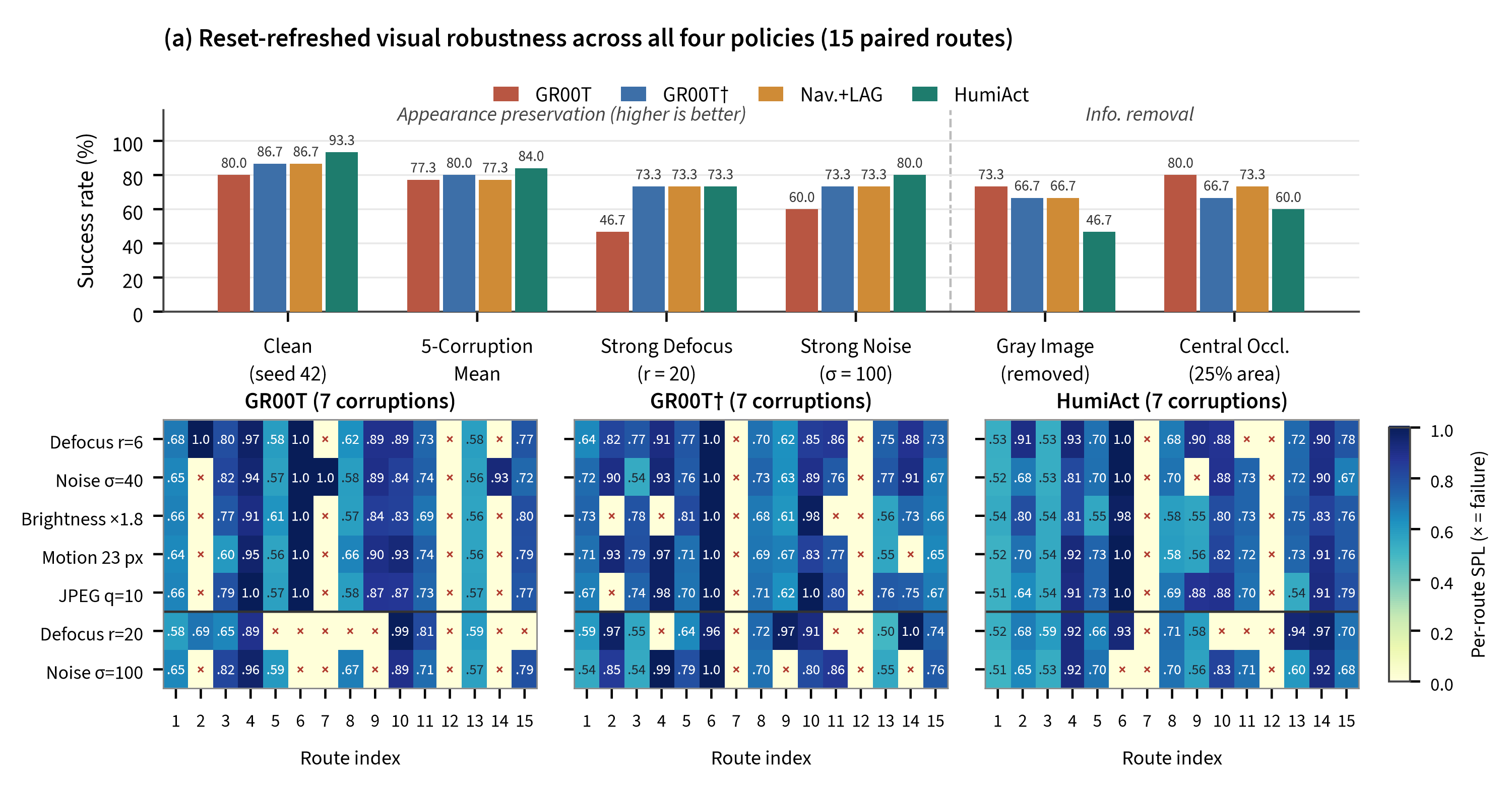
Under clean RGB, HumiAct reaches 93.3% SR and nearly halves lateral drift relative to blind gait replay (0.21 m vs. 0.39 m, matching 0.23 m privileged-pose oracle steering). Across five standard appearance corruptions it leads at 84.0% mean SR and eliminates strong-defocus stalling (0/15 vs. 6/15 for GR00T, exact McNemar p = 0.031). Removing visual information completely (uniform gray) drops SR to 46.7%, confirming active closed-loop visual control.
Table 2a. Visual corruptions & removal (15 paired routes, seed 42; SR % / SPL).
| Condition | GR00T | GR00T† | Nav.+LAG | HumiAct |
|---|---|---|---|---|
| Clean RGB | 80.0 / .606 | 86.7 / .669 | 86.7 / .674 | 93.3 / .719 |
| Defocus (r = 6) | 80.0 / .634 | 86.7 / .687 | 73.3 / .516 | 80.0 / .629 |
| Noise (σ = 40) | 86.7 / .683 | 86.7 / .681 | 80.0 / .586 | 80.0 / .590 |
| Brightness (×1.8) | 73.3 / .550 | 66.7 / .502 | 73.3 / .529 | 86.7 / .614 |
| Motion blur (23 px) | 73.3 / .556 | 80.0 / .618 | 80.0 / .577 | 86.7 / .633 |
| JPEG (q = 10) | 73.3 / .560 | 80.0 / .626 | 80.0 / .562 | 86.7 / .649 |
| Mean of five | 77.3 / .597 | 80.0 / .623 | 77.3 / .554 | 84.0 / .623 |
| Strong defocus (r = 20) | 46.7 (6 st.) | 73.3 (0 st.) | 73.3 (0 st.) | 73.3 (0 st.) |
| Strong noise (σ = 100) | 60.0 / .443 | 73.3 / .559 | 73.3 / .521 | 80.0 / .553 |
| Gray image (removed) | 73.3 / .495 | 66.7 / .504 | 66.7 / .418 | 46.7 / .305 |
| Central occlusion (25%) | 80.0 / .574 | 66.7 / .492 | 73.3 / .479 | 60.0 / .443 |
Table 2b. Gait-replay calibration. Camera feedback halves lateral drift (0.21 m).
| Controller | Input | SR ↑ | SPL ↑ | Lat. ↓ |
|---|---|---|---|---|
| Non-learned references | ||||
| Open-loop gait | none | 80.0 | .616 | .39 |
| Heading hold | root yaw | 80.0 | .617 | .39 |
| Oracle steering | true pose | 86.7 | .807 | .23 |
| Learned policies (clean RGB) | ||||
| GR00T | RGB | 80.0 | .606 | .28 |
| GR00T† | RGB | 86.7 | .669 | .36 |
| Nav.+LAG | RGB | 86.7 | .674 | .25 |
| HumiAct | RGB | 93.3 | .719 | .21 |
| Learned policies (uniform gray) | ||||
| GR00T | gray | 73.3 | .495 | .50 |
| HumiAct | gray | 46.7 | .305 | .46 |
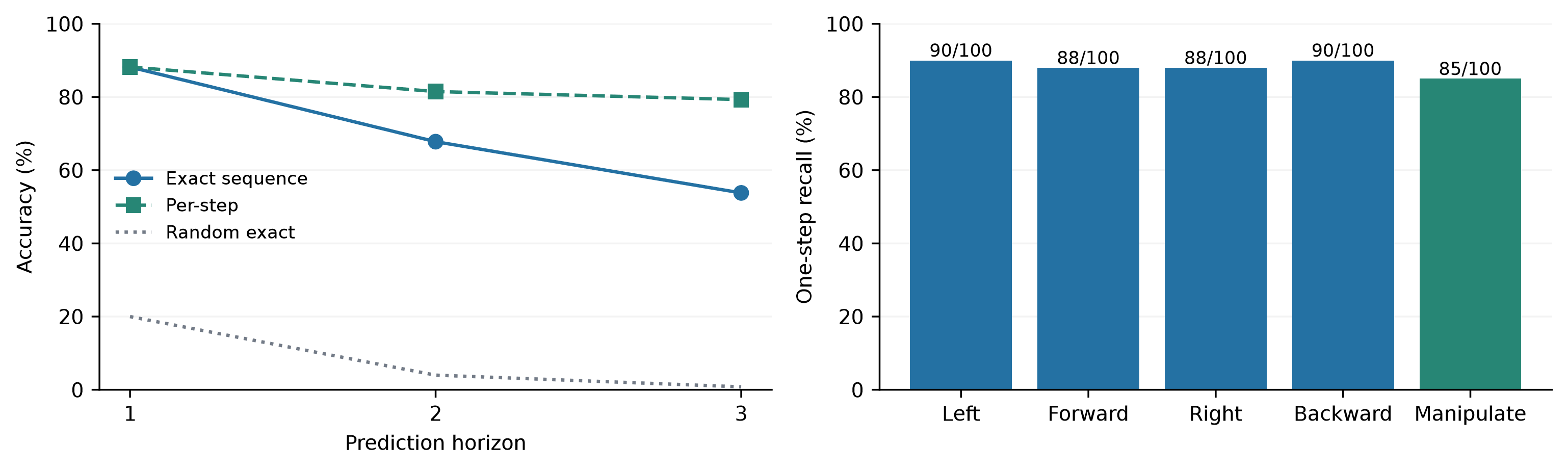
On 500 balanced held-out clips disjoint by source video and action record, the frozen UniAct predictor identifies the executed action with 88.2% one-step accuracy (85–90% recall across all five behaviors) and 53.8% exact 3-step sequence accuracy (vs. 0.8% chance). Permuting action labels collapses accuracy to 3.0%, proving that predictions follow the action condition rather than static visual statistics.
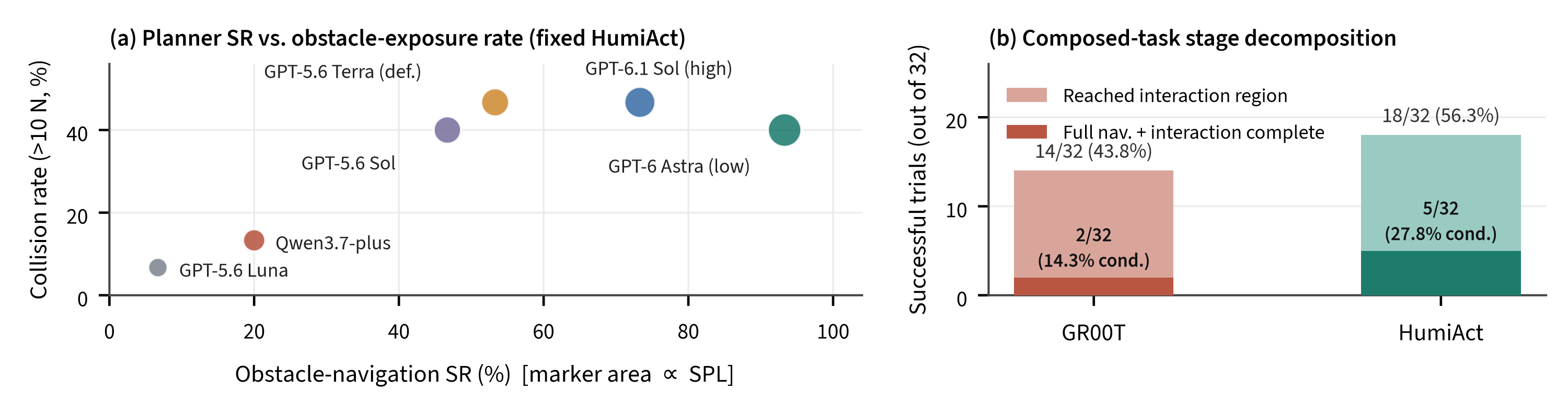
Holding the HumiAct motor policy fixed, varying only the high-level planner on the 15 obstacle routes spans 6.7% to 93.3% SR (GPT-6 Astra completes 14/15 routes with SPL 0.716). In LAG ablations, shuffling teacher action labels drops direct-navigation SR to 46.7% (below unguided GR00T), confirming that gains arise specifically from action-aligned future dynamics. On the physical 33-DoF humanoid, the adapted policy matches 3/3 left and right turns and improves forward walking (2/3 vs. 1/3 for GR00T).
Table 3a. Planner choice (fixed HumiAct checkpoint, 15 obstacle routes).
| Planner | SR ↑ | SPL ↑ | Coll. ↓ |
|---|---|---|---|
| GPT-6 Astra | 93.3 | 0.716 | 40.0 |
| GPT-6.1 Sol | 73.3 | 0.569 | 46.7 |
| GPT-5.6 Terra (default) | 53.3 | 0.410 | 46.7 |
| GPT-5.6 Sol | 46.7 | 0.379 | 40.0 |
| Qwen3.7-plus | 20.0 | 0.147 | 13.3 |
| GPT-5.6 Luna | 6.7 | 0.041 | 6.7 |
Table 3b. LAG ablation (SR %, Direct / Terra / 5-Corruption Mean).
| Distilled targets | Action | Direct | Terra | 5-Corr. |
|---|---|---|---|---|
| GR00T (none) | – | 66.7 | 33.3 | 77.3 |
| Current only | Aligned | 73.3 | 53.3 | 78.7 |
| Future only | None | 66.7 | 46.7 | 76.0 |
| Current + future | None | 73.3 | 46.7 | 80.0 |
| Current + future | Shuffled | 46.7 | 33.3 | 74.6 |
| HumiAct (both) | Aligned | 86.7 | 53.3 | 84.0 |
BibTeX
@article{hao2026humiact,
  title   = {Beyond Decoupled Control: Rethinking Whole-Body Navigation for Humanoid Robots},
  author  = {Hao, Haihong and Zhu, Hui and Zhuang, Tingda and Luo, Wenwen and Liang, Chen and Chen, Lei and Han, Mingfei and Chang, Xiaojun and Li, Zhihui},
  journal = {arXiv preprint},
  year    = {2026}
}